
SMA Publications
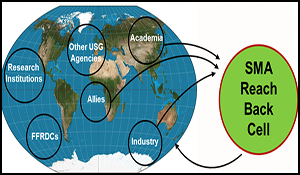
NSI maintains an extensive Publications archive of government-sponsored research and analysis products, various research efforts from our professional and technical staff, and a variety of corporate news items. The government-sponsored products are maintained on behalf of the US Department of Defense (DOD) Strategic Multilayer Assessment (SMA) program and address challenging national security problems and operational imperatives.


Question (R2 QL6): What are near and long term Turkish interests and intentions in Syria and Iraq? What are Turkish interests and intentions with respect to al-Bab?
Author | Editor: Astorino-Courtois, A. (NSI, Inc).
Despite policy shifts Turkey’s key interests remain the same
The SME contributors to this SMA Reach-back write-up argue that the recent changes in Turkish security policy (e.g., pursuit of ISIL along with the PKK; relaxing of demands for Assad’s removal; warming relations with Russia, etc.) do not necessarily indicate that Turkey’s key interests and intentions have changed. Rather, the shifts should be seen as changes in objectives or tactics that are still thoroughly consistent with Turkey’s fundamental and enduring security interests: 1) containing and ultimately eliminating Kurdish or other threats to Turkey’s internal stability; and, 2) foiling Kurdish (or others’) ambitions that threaten the integrity of Turkey’s borders. Former Principal Deputy Director of National Intelligence David Gompert (USNA, Rand) explains that recognizing Turkey’s dire concern with territorial integrity goes a long way in clarifying what may at first blush appear to be inconsistent policies regarding Assad, Syria, ISIL and even its “traditional enmity” toward Russia. Gompert expresses the message clearly: “…we can count on the Turks to do whatever it takes to prevent Kurdish states on their southern border.”
Erdogan’s political ambition: a third fundamental interest?
While most SMEs focused on Turkish threat perceptions and the Turkey—Kurd/PKK conflict as a key motivator of Turkey’s actions in Syria and Iraq, Portland State University Turkey scholar Dr. Birol Yesilada argues that Turkey’s security policy and actions cannot be fully understood without including President Erdogan’s personal political ambitions and domestic political considerations as critical motivators of state behavior. According to Yesilada, President Erdogan is using operations in Iraq and Syria to demonstrate his government’s strength and ability to provide security to Turks in order to advance his domestic political agenda. Erdogan’s ultimate goal is to gain the backing to change Turkey’s constitution to support establishment of his “Turkish-style Presidency” – a highly centralized, some say oligarchic or dictatorial, Islamist regime. (It is interesting to note that to date, Erdogan’s movements and plans for his “Turkish- style” leadership mirror those Vladimir Putin followed to centralize political power in Russia into his hands.)
Key objectives underlying Turkey’s actions
The SME contributors to this write-up provided a number of truly expert and comprehensive essays on Turkey’s short and longer- term objectives in northern Syria and Iraq. Although not always mentioned in this context, as shown in the summary graphic, each objective has a clear and direct link to the two security internal territorial integrity) and/or Erdogan’s domestic political interest.
1) Defeating Terrorism.
Defeating terrorism against the Turkish state has generally meant the PKK in Turkey and Iraq and PYD/YPG in Syria, although once ISIL fighters brought the fight into Turkey, Ankara has expanded the focus of its efforts to include the Islamic State. The question of the impact on Turkey’s security policy of Erdogan’s bid ultimately to change Turkey’s Constitution is a compelling and difficult to isolate. However, Professor Yesilada (Portland State) cites polls that show the political benefit Erdogan gains from these efforts: “91% of Turks support Erdogan’s anti-terror campaign inside the country and 78% support his military intervention in Syria and Iraq (esp. re Mosul) and 88% view his security policies favorably.”
2) Impeding Kurdish political and territorial gain.
Containing Kurdish political and territorial gains and obstructing activities that might by design or inadvertently lead to an autonomous Kurdish entity on Turkey’s border, are critical Turkish objectives in northern Syria. Many experts see Turkey’s pursuit of Operation Euphrates Shield as motivated by the desire to carve out a buffer zone in northern Syria and drive a solid wedge between Kurdish-controlled territory to the east and west to thwart emergence of a contiguous Kurdish region in northern Syria, that from its perspective would threaten both Turkey’s internal stability and potentially control over its own territory.
3) Increasing Turkey’s regional role and influence.
A number of experts noted Turkey’s push to distance itself from EU and NATO. With respect to its recently thawed relations with Russia a number of the SMEs expect that Turkey will move cautiously in its relations with Russia as it seeks to as Gompert tags it, engage in “diversified outreach” to expand its list of international partners and carve out a more independent regional role for itself. They argue that Turkey has little to gain from upsetting the US to the degree that it loses US backing.
4) Assuring domestic support.
Finally, as suggested by the opinion poll results cited above, at present President Erdogan enjoys extremely high public approval for his security policy – especially along Turkey’s border. Continuing to demonstrate the government’s ability to provide security for Turks will be a key facet of Erdogan’s overall popularity and ability to push through his preferred changes to Turkey’s democratic system.
Opening al-Bab: Turkey’s Intentions
Operation Euphrates Shield began with the liberation of Jarabulus in August 2016. In November Turkish forces and allied rebel groups launched the assault to remove ISIL from al-Bab and have been bogged down there since.
Most contributors to this report see Turkey’s mid-range intentions in al-Bab as two-fold: to defeat ISIL and push it away from the Turkish border, and to drive a pro-Turkey wedge between Kurdish-controlled areas in northern Syria containing the PKK and PYD and strengthening Turkey’s buffer zone in north Syria. A number of the SMEs make the case that one of Turkey’s mid-term objectives in conducting Euphrates Shield is to diminish the prestige the YPG has gained as the US/Coalition’s “go-to” fighters in the area. Specifically, Turkey gains both domestically and internationally if its own Syrian rebel proxies can liberate al-Bab – the last ISIL stronghold in northern Syria — and perhaps help in Raqqah rather than cede those opportunities to the YPG. Benedetta Berti (Institute for National Security Studies, Israel) suggests that Turkey’s objective here is to guarantee itself influence regarding the details of any post-conflict resolution arrangements in particular what happens with regards to Syria’s Kurdish population.
What next?
News reporters, commentators and the SMA SMEs continue to speculate on Turkey’s next move after liberation of al-Bab. Some experts believe that once al-Bab is liberated Turkey-backed rebels will attempt to take the city of Manbij 50 km up the M4 from the YPG forces that helped liberate that city and establish a strong buffer from Jarabulus to al-Bab to Manbij. In fact, in a January 4, speech delivered two months into the battle for al-Bab President Erdogan assured Turks that al-Bab would be retaken from ISIL shortly and after that, that Turkey was “committed to clearing other areas where the terror organizations are nesting, especially Manbij.”
However, on 27 January Erdogan appeared to recant, stating that Turkey would “finish the job” in al-Bab, but not necessarily move beyond al-Bab to other areas of Syria. There is a domestic and a regional concern here: Turkey has taken most of its Euphrates Shield casualties in the fight for al-Bab. Erdogan pronouncement also comes at a time when Syrian government forces are moving toward al-Bab from Aleppo and the southwest. The softening of Erdogan’s rhetoric likely reflects Russian influence as the forces of its two allies – themselves long-time adversaries, could come up against each other in al-Bab. One alternative is posed by Woodrow Wilson Center expert Amberin Zaman6 who is cited in news reports as doubtful that Turkish forces or Turkey-backed rebels would move on Manbij in part because of the Coalition Special Forces that he believes remain there following liberation of the city. Instead Zaman suggests that the next move in Turkey’s battle against the YPG will be against Afrin which is also in Kurdish-controlled territory, but which is less populated than Manbij or al-Bab and so should prove less difficult to secure.
Contributing Authors
Dr. Birol Yeşilada (Portland State University), Dr. Benedetta Berti (Institute for National Security Studies, Israel), The Honorable David Gompert (US Naval Academy, RAND)
Compilation of Round 1 Questions.
Author | Editor: Rhem, S. (SRC & SMA Team).
Round 1 Questions
Quick Look
- What are the factors that could potentially cause behavior changes in Pakistan and how can the US and coalition countries influence those factors?
- What are the strategic and operational implications of the Turkish Army’s recent intervention in northern Syria for the coalition campaign plan to defeat ISIL? What is the impact of this intervention on the viability of coalition vetted indigenous ground forces, Syrian Defense Forces and Jabhat Fatah al-Sham (formerly ANF)?
- What does primary source opinion research tell us about population support for ISIL in ISIL- held Iraq and globally outside the Combined Joint Operation Area (CJOA) (Syria and Iraq)?
- To what extent do populations maintain positive views of ISIL or ISIL’s ideology, particularly in European, N. African and Arabian Peninsula countries most associated with foreign fighter flows into Syria and Iraq? What are the general perceptions associated with ISIL endorsed themes, to include: 1) desire for re-establishing the Caliphate; 2) imposition of Shariah law; 3) belief that the Ummah/Islam is under attack from the West; 4) low tolerance for non-Sunni Muslim ethno-religious groups; 5) negative disposition towards gender equality?
- What are the predominant and secondary means by which both large (macro-globally outside the CJOA, such as European, North African and Arabian Peninsula) and more targeted (micro- such as ISIL-held Iraq) audiences receive ISIL propaganda?
ViTTa
- What are the USCENTCOM and the global counter-ISIL coalition missing from counter-messaging efforts in the information domain?
- What are the key factors that would impact the wave of violent extremism and ideological radicalism that affect the Sunni community?
- What long-term actions and processes should US government institutions, the Coalition, and the international community examine to position ourselves against a long term ISIL threat? How can the private sector be effectively engaged by government institutions to optimize the effects needed for success?
- What are the most likely post-ISIL Iraq scenarios with regards to Political, Military, Economic, Social, Information, Infrastructure, Physical Environment and Time (PMESII- PT)? Where are the main PMESII-PT friction points, which are most acute, and how are they best exploited to accomplish a stable end-state favorable to US and Coalition interests?
- What are the factors that will influence the future of Syria and how can we best affect them?
- What are the strategic and operational implications of the Iran nuclear deal on the US-led coalition’s ability to prosecute the war against ISIL in Iraq and Syria and to create the conditions for political, humanitarian and security sector stability?
- What are the strategic objectives and motivations of indigenous state and non-state partners in the counter-ISIL fight?
Literature Review
- What opportunities are there for USCENTCOM to shape a post-ISIL Iraq and regional security environment promoting greater stability?
- What will be Iran’s strategic calculus regarding Iraq and the region post-ISIL? How will JCPOA impact the calculus? What opportunities exist for the US/Coalition to shape the environment favorable to our interests?
- What action and policies can regional and coalition nations employ to reduce recruitment of ISIL inspired fighters?
- What is the strategic framework for undermining ISIL’s “Virtual Caliphate”?
- Given the generational nature of the threats we face, what changes in organization, legislation, authorities, resources, infrastructure, education, and other areas should the USG make to become as agile, resilient, survivable, sustainable, technologically and intellectually dominant as required to protect our constitutional system and prevail in any conflict from the present until 2050?
Simulation
- What are the correlations between the US/coalition operational and tactical actions in theater effecting terrorist activity throughout the world (i.e., external events). For example, does the loss of ISIL controlled territory or kill/capture of an ISIL high value target lead to an increase/decrease in terrorist attacks in other areas of the world? Can location, intensity, duration or timing of attacks be predicted from a model?
- In light of their divergent goals and interests, what are the necessary factors that would permit the US-led coalition, regional stakeholders (including Israel, Russia and Iran) or jihadist groups to achieve their aims in Iraq and Syria? Where do disparate groups’ interests align and where do they diverge? What can the US-led coalition do to deny adversaries the ability to achieve their goals?
- What must the coalition do in the information environment to achieve its objectives in Iraq and Syria and how can it deny adversaries the ability to achieve theirs?
Round 2 Questions
- Follow-up questions to the responses to Quick Look Question 3 concerning opinion research data on popular support for ISIL (9 Sept 16 Memo):
- Have sentiments changed since the December 2014 polling? Have recent IO efforts in Mosul influenced these sentiments? What other means can we use to influence?
- In countries where polling shows favorable opinions of ISIL (Syria, Nigeria, Tunisia, Senegal and Malaysia), what does this tell us? What do these countries have in common? What is our best approach to influence/inform?
Follow-Up questions to the responses to Quick Look Question 5 on the predominant means by which ISIL promulgates its message (9 Sept 16 Memo):
- The response to QL5 noted that ISIL is moving to ZeroNet platform for peer-to-peer messaging, which is extremely robust to distributed denial-of-service (DDOS) attack/other counter measures. What effect could this have on Intel efforts?
- The wide-spread, public access to smartphones has been a game-changer for the distribution and production of propaganda. Is there more data available about the types of apps (e.g., WhatsApp, Facebook, Telegram, Viber) used on smartphones to distribute propaganda, and the methods through which this is accomplished?
New Questions:
- What are potential unanticipated complications or reactions (or “black swans”) with respect to defeating ISIL in al-Raqqah?
- What are near and long term Turkish interests and intentions in Syria and Iraq? What are Turkish interests and intentions with respect to al-Bab?
- What significance will small military groups, particularly in Northern Syria, have in a post-ISIL Levant? How should CENTCOM best shape or influence these groups?
- How does the U.S./Coalition view Shia extremism? Different from Sunni extremism? How do Sunni communities, Shia communities, MENA countries, and media perceive the U.S./Coalition position on combatting extremists?
- What internal factors would influence Iran’s decision to interfere with the free flow of commerce in the Strait of Hormuz or the Bab el Mandeb?
- What improvements can be made towards the development of a comprehensive process to rapidly Build Partner Capacity (BPC) in select contingency scenarios (acquisition, fielding, distribution, maintenance and accountability of materiel)?
- What major economic, political and security (military) activities does KSA and Iran currently conduct in Bahrain, Lebanon, Iraq, Syria, and Yemen to gain influence? What are KSA and Iran’s ultimate goals behind these activities? What motivates KSA and Iran towards these goals? What future activities might KSA and Iran conduct in Bahrain, Lebanon, Iraq, Syria, and Yemen?
- How does the Israeli Palestinian Conflict influence, effect, and relate to current conflicts in the region?
- What are the key factors or elements within the Government of Iraq that influence overall stability in Syria and Iraq? What are the tipping points for each?
Question (R2 Special): What are the indicators of changes in Russian strategic interests in Syria?
Third Round of Questions from CENTCOM
- Quick Look Questions on Iraq (Due mid-Dec 2016)
- Are Government of Iraq initiatives for political reconciliation between the sectarian divide moving in step with military progress against Da’esh, and what conditions need to be met in order to accommodate the needs of the Sunni population?
- How does Da’esh’s transition to insurgency manifest itself, and what actions should the Coalition take to minimize their ability to maintain either military effectiveness or popular support?
- What are the aims and objectives of the Shia Militia Groups following the effective military defeat of Da’esh?
- What are the critical elements of a continued Coalition presence , following the effective military defeat of Da’esh that Iran may view as beneficial?
Quick Look Questions on Syria (Due end of January 2017)
- Following the clearance of Da’esh from both Mosul and Raqqah , and beyond that any remaining substantive elements in the Euphrates River Valley, what governing structure is most likely to be effective, and acceptable to the predominant tribes?
- How will the population in northwest Syria react to future Salafist political institutions?
- How does Da’esh ‘s transition to insurgency manifest itself in Syria; which other jihadist groups might offer the potential for merger and which areas of ungoverned space are most likely to offer conditions conducive for Da’esh to maintain some form of organizational structure and military effectiveness?
Question (R4.7): What are the respective national interests of the US and Russia in the Middle East, and what are the options for alleviating US/Russian tensions to mutual satisfaction and improved regional stability?
Author | Editor: Polansky (Pagano), S. (NSI, Inc.).
Executive Summary
The geopolitical foundation of the Middle East is undergoing a fundamental shift in paradigm, with both the US and Russia adapting their national interests to fit the current reality. As part of this shift, Bogdan Belei of the Carnegie Endowment contends that US national interests in the Middle East are diminishing due to a combination of affordable and abundant domestic energy sources as well as the end of the Cold War. Yet a calm and stable Middle East remains a critical US security objective that underpins other key US interests in the region (Lamoreaux). As Blago Tashev of the Marine Corps University notes (personal communication), “the US sees itself as a status-quo power, maintaining a particular rules-based international order that was created by the US and its allies after WWII and is based on values shared by America and those allies.”
Yet many of the SMA experts note that a driving Russian interest is to restore its image as a US-peer “Great Power” in part by expanding its economic, military, and diplomatic ties to the Middle East. Specifically, Belei, Tashev, and Marten argue that Russia’s goal is to end what it sees as two decades of American unilateralism in the Middle East. Tashev argues that Russia’s moves in the Middle East should ultimately not be viewed as aimed at eliminating US presence there rather, the goal is to achieve parity with the US in terms of Russia’s influence in the region. Marten emphasizes that Russian national interests are not necessarily the same as Putin’s own interests, and that Putin has and will put his own interests first. While “the US views the Middle East in terms of global interests and a global strategy, Russia by contrast looks at the region more in terms of the political legitimacy of the Putin government (validated by external successes) and in terms of regional tactics” (Braun, personal communication). Ultimately, according to Tashev (personal communication), Russia not only differs from the US and its allies in terms of values, but also uses different strategies and policies to attain outcomes consistent with its national interests.
US versus Russian Interests in the Middle East
US Interests
The collective input of the contributors identifies four categories of US national objectives in the Middle East: stability, security, economic, and democratization, with a strong emphasis on the former two.1 Lamoreaux argues that while a stable Middle East—including a non-confrontational Israel—is important to the US, a stable Europe is an even more pressing interest, largely due to economic considerations. He suggests that the best way to encourage both Israeli calm and European stability is to ensure stability in the Middle East.2 In service of this latter goal, Lamoreaux indicates that the US should continue present policy and interactions both with Saudi Arabia and with Egypt, given the current (relative) stability in those states. Similarly, Turkey must also be dealt with carefully, given the risk of destabilization to the EU posed by President Erdogan’s treatment of Syrian and Iraqi refugees (Lamoreaux).
US security interests include long-term partnerships with reliable allies within the region (Israel, Turkey, GCC, Jordan, Iraq, and Egypt) (Belei). “These relationships center on stability within the confines of effective governance, yet do not require a uniform approach either towards ‘democracy,’ nor a standardized bilateral model for US engagement—variable interests and dynamic relationships remain the hallmark of the region” (Meredith, personal communication). Within that flexible approach, firm “red line” strategies include containing Iran (Belei); counter-terrorism/counter-ISIS activities (Belei, Lamoreaux, Tashev); and preventing the development, proliferation, or use of weapons of mass destruction (Tashev).
US economic interest centers around the free flow of energy from the Middle East to the world (Tashev), including freedom of navigation, as well as maintaining sufficient capacity to monitor and potentially offset Russian naval activities in the Mediterranean (Meredith, personal communication). As Tashev discusses (personal communication), protection of strategic assets, economic, and other interests give rise to the US need to provide security over the non-littoral sea lines in the Middle East; the region is especially important given the presence of three important naval choke points—the Suez Canal, the Bab el-Mandeb Strait, and the Strait of Hormuz. Maritime traffic through these choke points has and will continue to face multiple threats, even though the US historically has maintained freedom of navigation. This freedom will decline should US capacity and willingness to provide security be reduced—thereby creating an opportunity for actors such as China or Russia to gain increased influence in the region (Tashev, personal communication). A forward naval deployment strategy to protect and control sea lines of communication (SLOCs) between Persian Gulf and Horn of Africa, as well as the greater Indian Ocean, would assist in protecting the US interest in energy security (Belei, personal communication).
Additional economic interests are “the dividend of stability and effective governance, namely the development of competitive, reliable markets for regional and global trade;4 employment growth to absorb and redirect fighting age males who would otherwise not join violent organizations; and broader tax bases for partner nations to establish capable government services and develop more legitimate social contracts” (Meredith, personal communication). Ultimately, the US views stable economic growth in the region as contributing to overall stability in the region, thus serving another core US interest (Tashev, personal communication).
The US interest in democratization (Tashev; cf. Lamoreaux) includes an emphasis on human rights, but also a recognition that democratization destabilizes political and social relationships, which must be managed carefully by partner nations (Meredith, personal communication). However, there was some disagreement among contributors regarding the importance of democratization as a US interest. Lamoreaux argues that the US does not have a current interest in democratization, but instead is focused on stability, even if this stability comes at the expense of the former (personal communication).
Russia Interests
Russia shares with the US one primary interest: security in the Middle East, which at present centers on counter-terrorism/counter-ISIS (Belei, Braun, Lamoreaux), thereby diminishing the threat of its brand of Islamist extremism expanding into Russia and its neighbors (Tashev). To serve this security interest, Russia is motivated to build alliances in the region, especially with friendly states like Iran, Egypt and more recently Turkey; more broadly to also establish good bilateral relations with all states (Belei, Tashev).
Lamoreaux points out that Russia’s interest in counter-terrorism may not be completely straightforward. He posits that Putin may not particularly want radical Islamic terrorism to be completely eliminated because some level of threat assists him in maintaining legitimacy and influence in the old Soviet sphere of influence (the Caucuses region and increasingly in the “Stans” as well), as the threat of terrorism increases across Central Asia. Russia’s interest in controlling terrorism is served by its continued involvement in Syria. Consistent with this claim, Marten notes that Putin’s primary goals in Syria are to support the Assad regime and eliminate Assad’s competitors; a pivot to defeating ISIS will occur after these goals have been achieved.
Russia also has economic interests in the Middle East, including expanding economic ties with the region through arms sales, nuclear technology, and the oil and gas markets (Belei, Marten, Tashev), as well as supporting energy prices by coordination with principal oil and gas producers in the Persian Gulf (Tashev).
Russia’s secondary interests in the Middle East otherwise focus on countering US and Western influence. This includes efforts to weaken the EU and West more generally, as well as a destabilized Syria, which is believed will contribute to a destabilized EU by fracturing it along multiple fronts (Lamoreaux).5 Putin also has an ongoing interest in undermining or complicating US diplomatic leadership in the Middle East and elsewhere in order to enhance domestic and regional perceptions of his strength and US weakness (Marten). Similarly, Putin is likely to use diplomatic overtures to further complicate and harm the US relationship with countries in the Middle East (Marten). Each of these actions serves Russia’s goal to regain global stature and contest US presence in the region (Serwer). Toward this goal, Russia aims to reestablish its influence in Libya, Egypt, Turkey, and Iran by filling the gaps left by the US (Serwer); Russia establishing a military presence in the Middle East will be a likely consequence of this objective (Belei).
Prognosis for Reducing US/Russian tensions and Improving Regional Stability
Several contributors indicated that the prospects for US-Russia cooperation in the Middle East are relatively poor (Belei, Braun, Marten, Serwer, Tashev). Braun (personal communication) notes, “In certain key areas, the differences between Putinite Russia and the US are more than tactical or even strategic; they are fundamental and cannot be bridged.” Meredith asserts that, while global competition has been tempered somewhat by US and Russian desires to control escalation to the point of outright conflict, the mutual restraint in US-Russian relations characteristic of the Cold War has not yet fully re-emerged. “This absence of mutual restraint is in part because the Russian paradigm remains zero-sum at its core—which leads to divergent interests vis-à-vis Iran, Syria, and Turkey as core actors in either the Western or Russian sphere of influence” (Meredith, personal communication). Belei argues that contrasting US and Russian interests also lead to opposing activities in the region that are fundamentally at odds. For example, in Syria and Libya, Russia opposes factions that the US supports; whereas in Afghanistan, Russia bolsters Taliban fighters who target US forces (Belei, Marten). According to Braun and Marten, as long as Putin relies on external events for internal political legitimation, a true resolution of tensions between the US and Russia will be difficult to achieve. This is underscored by Russian investment and military operations in Syria, warming relations with Iran (Braun), and intensification of relations, including with non-state actors, in the region (Tashev). Overall, Marten argues, Putin does not have much incentive to cooperate with the US in regards to defeating ISIS, unless he can portray the West as having capitulated to him and/or the US publicly acknowledges Russia’s leadership in resolving the conflict.
A more optimistic view of the situation suggests that it is possible that the US and Russia can converge on an interest in regional stability6 (Meredith, Tashev) “in the short term—seeking to contain and eventually diminish levels of violence—while recognizing stable governance can become an area for democratic development, itself a stabilizing force over the long term” (Meredith, personal communication). Neither the US nor Russia is interested in a protracted war and thus the tension might also reach a stalemate that would force both countries to engage in a political agreement (Belei). Barring these situations, prolonged conflict—or in the worst-case scenario, direct confrontation—is possible (Belei, personal communication).
Recommendations
The contributors offer a wide range of recommendations for reducing tension between the US and Russia in the Middle East. These are focused primarily on Syria and Russia itself, and include:
Syria
- “Cool off in Syria,” and conclude this conflict as soon as possible. Doing so includes abandoning the policy of regime change in Syria, instead focusing on eroding ISIS-held territory and ensuring that the cities are functional security environments (Belei, Lamoreaux, Meredith)
- Allow Assad to remain in Syria but insist that he work with primary opposition groups and agree to some sort of amnesty for rebel fighters (Lamoreaux)
- Institute more general checks on Assad so that he does not eliminate the competition once talks are done. Ensure that Assad surrenders the majority of his arms with the stipulation that others (Russia, possibly Turkey) enforce the agreement under UN auspices (Lamoreaux)
Russia
- The US and EU should ease sanctions on Russia as these do not seem to be effective, and no one will intervene militarily on behalf of the Ukrainian government (Lamoreaux)
- US policy toward Russia in the Middle East should not be compartmentalized. Take into account that Russia’s activities in the Middle East are tied to its moves elsewhere, as well as its military posture toward the US—all intended to restore Russia’s great power status (Tashev)
- The US should not explicitly include talk of human rights and democracy in its policy discussions with Russia, as the latter views these goals as destabilizing (Tashev)
- Minimize the emphasis on the use of force to achieve US goals in the Middle East as this prompts Russia to engage in asymmetrical response (Tashev)
Contributing Authors
Bogdan Belei (Carnegie Endowment for International Peace), Aurel Braun (University of Toronto & Harvard University), Jeremy W. Lamoreaux (Brigham Young University – Idaho); Kimberly Marten (Barnard College, Columbia University), Spencer B. Meredith III (National Defense University), Daniel Serwer (Johns Hopkins School of Advanced International Studies), Blago Tashev (Center for Advanced Operational Culture Learning, Marine Corps University)

Question TAB A: 4th Round Quick Look Questions
Author | Editor: SMA Program Office.
SMA Round Four Questions
- How strong a factor is Iraqi nationalism in countering Iranian influence?
- How could DoD and DoS be better postured to address regional and world conflicts to ensure a whole of government approach to identify and synchronize lines of effort in both planning and execution?
- To what extent is the Iraqi Army apolitical? Do they have a political agenda or other desired end-state within Iraq? Could the Iraqi military be an effective catalyst for reconciliation between different groups in Iraqi society? Could conscription be an accelerant for reconciliation, and if so how could it be implemented?
- What does a successfully concluded campaign against ISIS look like? Considering costs, reputation, and balance of influence, how should the U.S./Coalition define success? Is the defeat of ISIS a success if it causes the balance of power in the region to shift towards Iran, Assad, or Russia?
- Does U.S. foreign policy strike the right balance in supporting U.S. interests and its role as a global power? Or, should the U.S. consider a more isolationist approach to foreign policy? What impact could an isolationist policy have on Middle East security and stability, balance of influence by regional and world actors, and U.S. national interests?
- What are the competing national interests of the U.S. and Iran in the Middle East and what are the options for alleviating U.S. / Iranian tensions to mutual satisfaction and improved regional stability?
- What are the respective national interests of the U.S. and Russia in the Middle East and what are the options for alleviating U.S. / Russian tensions to mutual satisfaction and improved regional stability?
- Are there impediments to cooperation amongst GCC nations that reduce their effectiveness towards undesirable or adverse regional issues? If so, how could impediments be overcome?
- What are the medium to long-term implications to U.S. interests and posture of China’s economic, diplomatic and military expansion into South Asia, Middle East and Africa?
- Is the current U.S. approach to supporting Afghanistan beneficial? Or does it promote a cycle of dependency and counter-productive activities in the region? What strategic and local factors would need to be considered, managed and accepted in any significant change in military and/or other support?
- What are the implications for the U.S. and GCC countries if the Arab coalition does not succeed or achieve an acceptable outcome in Yemen?

SMA Reachback: Highlights From CENTCOM Round 1, 2 and 3 Questions.
Author | Editor: Astorino-Courtois, A. (NSI, Inc).
Overview
ISIS will be defeated militarily. However, whether it is ultimately overcome by containment or by deploying ground forces to apply overwhelming force, the path to mitigating violent extremism in the region is a generations-long one. Military options alone are insufficient to protect US interests and stabilize the region. It will require significant strengthening of State Department and non-DoD capacity to help build inclusive political institutions and processes in Syria and Iraq. Only if these flourish will ISIS — the organization and the idea it represents — have failed and the region been put on a sustainable path to stability
Contents
- Charter
- The Meaning of ISIS Defeat & Shaping Stability: Highlights from CENTCOM Round 1, 2 and 3 Reach-back Reports.
- Individual theme Executive Summaries 17 Messaging Executive Summaries.
- What are the predominant and secondary means by which both large (macro-globally outside the CJOA, such as European, North African and Arabian Peninsula) and more targeted (micro- such as ISIL-held Iraq) audiences receive ISIL propaganda? Executive Summary.
- What are USCENTCOM and the global counter-ISIL coalition missing from countermessaging efforts in the information domain? Executive Summary.
- What must the coalition do in the information environment to achieve its objectives in Iraq and Syria and how can it deny adversaries the ability to achieve theirs? Executive Summary Part 1.
- What must the coalition do in the information environment to achieve its objectives in Iraq and Syria and how can it deny adversaries the ability to achieve theirs? Executive Summary Part 2.
- The response to QL5 noted that ISIL is moving to ZeroNet platform for peer-to-peer messaging, which is extremely robust to distributed denial-of-service (DDOS) attack/other counter measures What effect could this have on Intel efforts? Executive Summary.
- The wide-spread, public access to smartphones has been a game-changer for the distribution and production of propaganda Is there more data available about the types of apps (eg, WhatsApp, Facebook, Telegram, Viber) used on smartphones to distribute propaganda, and the methods through which this is accomplished? Executive Summary.
- The Fight Against ISIS Executive Summaries.
- What are the strategic and operational implications of the Turkish Army’s recent intervention in northern Syria for the coalition campaign plan to defeat ISIL? What is the impact of this intervention on the viability of coalition vetted indigenous ground forces, Syrian Defense Forces and Jabhat Fatah al-Sham (formerly ANF)? Executive Summary.
- What is the strategic framework for undermining ISIL’s “Virtual Caliphate?” Executive Summary.
- What long-term actions and processes should US government (USG) institutions, the Coalition and the international community examine to position ourselves against a long term ISIL threat? How can the private sector be effectively engaged by government institutions to optimize the effects needed for success? Executive Summary.
- What are the strategic and operational implications of the Iran nuclear deal on the US-led coalition’s ability to prosecute the war against ISIL in Iraq and Syria and to create the conditions for political, humanitarian and security sector stability? Executive Summary.
- Have sentiments changed since the December 2014 polling? Have recent IO efforts in Mosul influenced these sentiments? What other means can we use to influence? Executive Summary.
- What are potential unanticipated complications or reactions (or “black swans”) with respect to defeating ISIL in al-Raqqah? Executive Summary.
- How does Da’esh’s transition to insurgency manifest itself, and what actions should the Coalition take to minimize their ability to maintain either military effectiveness or popular support? Executive Summary.
- Mosul Coalition Fragmentation: Causes and Effects.
- Encouraging Regional Stability Executive Summaries.
- What are the factors that could potentially cause behavior changes in Pakistan and how can the US and coalition countries influence those factors? Executive Summary.
- What are the most likely post-lSIL Iraq scenarios with regards to Political, Military, Economic, Social, Information, Infrastructure, Physical Environment, and Time (PMESII-PT)? Where are the main PMESII-PT friction points, which are most acute, and how are they best exploited to accomplish a stable end state favorable to US and coalition interests? Executive Summary.
- What opportunities are there for USCENTCOM to shape a post-ISIL Iraq and regional security environment promoting greater stability? Executive Summary.
- What are the factors that will influence the future of Syria and how can we best affect them? Executive Summary.
- What are the strategic and operational implications of the Iran nuclear deal on the US-led coalition’s ability to prosecute the war against ISIL in Iraq and Syria and to create the conditions for political, humanitarian and security sector stability? Executive Summary.
- What will be Iran’s strategic calculus regarding Iraq and the region post-ISIL? How will JCPOA impact the calculus? What opportunities exist for the US/Coalition to shape the environment favorable to our interests? Executive Summary.
- What significance will small military groups, particularly in Northern Syria, have in a post- ISIL Levant? How should CENTCOM best shape or influence these groups? Executive Summary.
- How does the Israeli-Palestinian Conflict influence, affect, and relate to current conflicts in the region? Executive Summary.
- What are the key factors or elements within the Government of Iraq that influence overall stability in Syria and Iraq? What are the tipping points for each? Executive Summary.
- Regional Actor Interests and Motivations Executive Summaries.
- What are the strategic objectives and motivations of indigenous state and non-state partners in the counter-ISIL fight? Executive Summary.
- In light of their divergent goals and interests, what are the necessary factors that would permit the US-led Coalition, regional stakeholders (including Israel, Russia, and Iran), or jihadist groups to achieve their aims in Iraq? Where do disparate groups’ interests align and where do they diverge? What can the US coalition do to deny adversaries the ability to achieve their goals? Executive Summary.
- What are near and long term Turkish interests and intentions in Syria and Iraq? What are Turkish interests and intentions with respect to al-Bab? Executive Summary.
- What internal factors would influence Iran’s decision to interfere with the free flow of commerce in the Strait of Hormuz or the Bab el Mandeb? Executive Summary.
- What major economic, political and security (military) activities does KSA and Iran currently conduct in Bahrain, Lebanon, Iraq, Syria, and Yemen to gain influence? What are KSA and Iran’s ultimate goals behind these activities? What motivates KSA and Iran towards these goals? What future activities might KSA and Iran conduct in Bahrain, Lebanon, Iraq, Syria, and Yemen? Executive Summary.
- What are the indicators of changes in Russian strategic interests in Syria? Executive Summary.
- What are the aims and objectives of the Shia Militia Groups following the effective military defeat of Da’esh? Executive Summary.
- What are the critical elements of a continued Coalition presence, following the effective military defeat of Da’esh [in Iraq] that Iran may view as beneficial? Executive Summary.
- Sources of Extremism Executive Summaries.
- What are the key factors that would impact the wave of violent extremism and ideological radicalism that affect the Sunni community? Executive Summary.
- What are the correlations between the US/coalition operational and tactical actions in theater effecting terrorist activity throughout the world (ie, external events) For example, does the loss of ISIL controlled territory or kill/capture of an ISIL high value target lead to an increase/decrease in terrorist attacks in other areas of the world? Can location, intensity, duration or timing of attacks be predicted from a model? Executive Summary.
- ISIL Support and Recruitment Executive Summaries.
- What does primary source opinion research tell us about population support for ISIL in ISIL- held Iraq and globally outside the Combined Joint Operation Area (CJOA) (Syria and Iraq)? Executive Summary.
- To what extent do populations maintain positive views of ISIL or ISIL’s ideology, particularly in European, N African, and Arabian Peninsula countries most associated with foreign fighter flows into Syria and Iraq? Executive Summary.
- What actions and polices can regional and coalition nations employ to reduce recruitment of ISIL inspired fighters? Executive Summary.
- USG Bureaucratic Requirements Executive Summaries.
- Given the generational nature of the threats we face, what changes in organization, legislation, authorities, resources, infrastructure, education, and other areas should the USG make to become as agile, resilient, survivable, sustainable, technologically and intellectually dominant as required to protect our constitutional system and prevail in any conflict from the present until 2050? Executive Summary.
- Post ISIL Governance Executive Summaries.
- Are Government of Iraq initiatives for political reconciliation between the sectarian divide moving in step with military progress against Da’esh, and what conditions need to be met in order to accommodate the needs of the Sunni population? Executive Summary.
- Following the clearance of Da’esh from both Mosul and Raqqah, and beyond that any remaining substantive elements in the Euphrates River Valley, what governing structure is most likely to be effective, and acceptable to the predominant tribes? Executive Summary.
- How will the population in northwest Syria react to future Salafist political institutions? Executive Summary.
- Coalition Views Executive Summary.
- How does the US/Coalition view Shia extremism? Different from Sunni extremism? How do Sunni communities, Shia communities, MENA countries, and media perceive the US/Coalition position on combatting extremists? Executive Summary.
Question (R3 QL6): How will the population in northwest Syria react to future Salafist political institutions?
Author | Editor: Astorino-Courtois, A. (NSI, Inc).
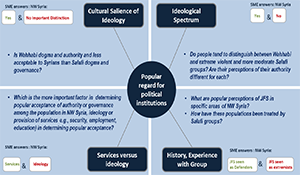
Similar to points made by other contributors to this SMA Reach-back report, Dr. Kathleen Reedy of Rand includes a caveat in her response to the CENTCOM question. Given international pressure to avoid Salafi expansion in Syria, it is doubtful she argues, that Salafist policies or leaders would be allowed to become dominant over sizeable areas of northwest Syria. Nonetheless, contributors’ input on the likely response to future Salafist political institutions in northwest Syria tends to align with one of two viewpoints: 1) Syrians will reject Salafi efforts to establish political institutions (i.e., to govern); or 2) Salafi governance will be accepted under certain circumstances.
In addition, the experts offer a range of key factors to support either the “reject” or “accept with conditions” conclusions. These factors suggest four areas of inquiry: 1) the cultural salience of Salafism in Syria; 2) the degree to which people differentiate among political groups; 3) popular views of, and experience with political groups; and 4) the relative importance of ideology versus provision of public services.
Questions #1 and #2: The Cultural Acceptability of Salafism & Ideological Differentiation
Professor Murhaf Jouejati of the National Defense University contends that Syrian culture is a more apt foundation for moderate than for extremist Islamic practices. Salafism, which represents the culture of the Arabian Peninsula, is foreign to Levantine culture and as a result Syrians are most likely to reject Salafist institutions or reforms. Jouejati recalls that in the past Syrians living in areas controlled by radical extremists engaged in civil disobedience and demonstrations and sees little reason that these types of activities would not occur in areas taken or retaken by ISIL, Al Qaeda or Jabat Fatah al Sham (JFS). Charles Lister, a senior fellow at the Middle East Institute, adds that even within the opposition there is a preference for the Syrian national movement “initiated by peaceful protesters advocating for moderate ideals, rather than the transnational jihadis like Al-Qaeda.” He warns though that “that dynamic is not necessarily immovable.”
Mubin Shaik of the University of Liverpool provides a variation on this argument. He maintains that in fact Syrians differentiate between Salafists and “Saudi style Wahhabists” so would not necessarily reject all Salafist governors or political institutions. It is the particular Wahhabism of the Islamic State that is countercultural in this area. Finally, Dr. Joshua Landis (University of Oklahoma) warns that the issue of the cultural salience of Salafism in Syria may be becoming moot. While he concedes that many Syrians are “fed up with fundamentalism” because of the harsh treatment they received at the hands of JFS and then ISIL, he argues that over the past six years of conflict the Syrian population has been radicalized as, consciously or not, Salafi ideas and practices have been accepted into their psyches and aspects of their daily lives where they were not necessarily present before.
Question #3: Popular Experience with Salafi Groups
Charles Lister (MEI) argues that the fall of Aleppo, the moderate opposition’s key safe haven in Syria, had the effect of diminishing popular confidence in moderate civil society. However, because in his view JFS failed to demonstrate its military value to the Syrian revolution it is now seen as “impotent” by local populations and enjoys “only minimal respect” in civil affairs. Mubin Shaik (University of Liverpool) on the other hand, believes that Salafist groups like Al Qaeda and Jabat Fatah al Sham have succeeded in building the foundation for public support of their leadership by encouraging locals to see them as defenders of the interests of the Syria people as opposed to other groups who they peg as the flunkies of the regime or of the West. As a result, Shaik expects that Salafist groups will be accepted by local populations as long as they continue their gradualist approach to instituting socially conservative (Salafist) practices.
Question #4: The Relative Importance of Goods versus Ideology
Finally, in line with the conclusions of other SMA Reach-back write-ups (e.g., see R3 QL5, V7), Joshua Landis (University of Oklahoma) argues that local support for one governing structure over another will not be a function of ideology or religious preference as others intimate, but a function of which government can provide goods and services to its constituents. Landis notes that people in northwest Syria are, and will remain, in dire need of employment, security and education and the government that best provides these goods will receive their allegiance. In a specific instance of this argument Lister (MEI) forecasts that continued civil conflict in Syria will eventually bring the people of the Idlib and Hama governates into the regime’s sights and in urgent need of defense. Lister warns that if the Coalition were to discontinue support for moderate forces, local populations may again see no option but to align with Salafi groups for their defense.
The Result
As is clear from the review of their arguments, there is no clear consensus on the prospects for Syrian acquiescence to Salafi authority and/or attempts to govern in the northwest of the country. It is also unclear which factors would be the most important determinants of popular support or rejection of Salafi control. Producing a more definitive answer to the CENTCOM question requires further study and data collection on the ground. In short, in both cases – expectations and critical variables – the jury is still out.
What the experts’ input does suggest however, is arguably more useful than a single, consensus answer to (any) question of popular desire or preference in such a volatile environment. Taken together the experts’ contributions to this report imply a series of important questions that provide a template for assessing or engaging with local preferences for governing structures (e.g., Salafi, Assad regime, or moderate Islamist, etc.) in both Syria and Iraq. Specifically, analysts and planners should tailor and seek to answer the following questions relative to their areas of interest:
- Is the prospective government or governing system salient to, and consistent with local culture?
- Do opponents/supporters of the prospective government or system differentiate among proposed leaders, or are all elements or factions of the proposed governing authority seen as unacceptable/acceptable?
- What history or past experiences do local constituents have with the prospective government?
- What is the relative importance of religious and/or ideological beliefs and government provision of goods and services (e.g., security, employment, etc.) in determining popular acceptance of a governing authority?
The Accept-Reject figure above shows these generic questions tailored for the question of popular support for Salafi political institutions in NW Syria, and provides a useful roadmap for further study and on-the-ground data collection.
Contributing Authors
Dr. Kathleen Reedy (RAND), Dr. Murhaf Jouejati (National Defense University), Dr. Amjed Rasheed (Durham University, UK), Mubin Shaikh (University of Liverpool; independent consultant), Dr. Joshua Landis (University of Oklahoma), Charles Lister (Middle East Institute)
Question R2 (QL4): The wide-spread, public access to smartphones has been a game-changer for the distribution and production of propaganda. Is there more data available about the types of apps (e.g., WhatsApp, Facebook, Telegram, Viber) used on smartphones to distribute propaganda, and the methods through which this is accomplished?
Author | Editor: Ziemke, J. (John Carroll University).
Twitter & Facebook?
Todd Huffman and Ryan Paterson shared their analysis of the top fifty applications and services used over the last three months to spread VEO propaganda. Top on the list are applications for Twitter, Facebook, and WordPress, among others as shown in the Appendix. Our contributors also highlighted others: Fred Morstatter (ASU) flagged Telegram, as well as custom-made apps, while Randy Kluver (TAMU) remarks that alternative platforms tacitly supported by foreign governments (such as Wechat or VKontakte) “re-create the geographical and political divisions that most assumed were ending with the rise of a globalized world.” However, many authors argue that the issue is truly platform neutral, and that message circulation is just as effective in any number of other platforms. Rebecca Goolsby (ONR) additionally surmised that the way in which the question was asked explains the “Twitter and Facebook” answer received. Contributors felt that gaining traction on this issue first requires understanding how VEO’s leverage social media and vulnerable audiences to attain their goals. We turn to Rebecca Goolsby to elaborate on this issue.
“Anyone that is a true believer in X must also believe Y”
Goolsby asserts that a goal of any VEO is to transform, create, and reframe a conversation by deploying “side-step logic”, which amounts to: If you truly believe X, then you must also believe and support Y. The crafty use of this logical fallacy is what leads hyper-connected yet vulnerable audiences to leverage social media to recirculate and thus amplify the message. She says a VEO wants “to turn the conversation so that the audience believes if they support Healthy Kittens for America, then they must naturally support . And if you don’t support , how can you call yourself a Friend of All Kittens?”
Since the narrative is pitched to the target audiences’ deep biases, values, and worldview, the audience does not engage in critical thinking about the information. Because the audience emotionally ‘knows’ that X is true (and right) in its emotional mind, then it accepts the parasite narrative without thorough consideration of its origins, implications, or agenda. And since the audience finds that more and more of its trusted peers are echoing this information, critical evaluation is further suppressed.
At the same time, the VEO insinuates itself into the information networks of the target audience in a way that displays this vulnerability, repeating and amplifying the motifs and sub-narratives that reflect its agenda, until it is hard to find where the host narrative and the parasite narrative are differentiated. The target audience is then repeatedly exposed to the parasite narrative through covert means, using computerized amplification methods (e.g. botnets, fake news).
Audiences as unwitting vectors of amplification
How do the VEO’s reframe the conversation that makes this ‘logical’ side-step possible? By manipulating vulnerable audiences into recirculating this information for them. Messages are amplified by vulnerable audiences and paid intermediaries who recirculate these messages, drowning other views. Goolsby asserts that “the reason phones are a game changer is that it is the easiest and cheapest access to the Internet available to most of the world. Newer users–the newbies- – are not especially sophisticated in their understanding of news and fake information, but everyone has cognitive vulnerabilities–hot button issues–that can be exploited.” Nitin Agarwal (U. of Arkansas) elaborates on message amplification by noting that messages emerge in one medium but are then massively disseminated across several other platforms: “Strategies such as thread jacking, smoke-screening, hashtag latching, etc. are used to multiply the messages.”
Why share?
Youth in particular share or create these messages for a variety of different reasons. As digital natives, they want to be seen sharing insider information as a way to boast about privileged access to content from the frontlines. Youth compete to post information that shows just how enlightened they are about an issue relative to their peers, and to do so faster than anyone else. Jen Ziemke’s (John Carroll University) young students remark that when their friends spread information and pictures of weaponry and battlefield activity they do so “to make themselves look good amongst their friends who do not have such access to such exclusive content.” Still others share in order to feel like they belong to something, or to “feel cool,” or even to feel “morally superior to have shared something that helps craft one’s identity around an issue.”
Content Consumption & Recirculation
Many who end up sharing content start out by passively looking through media on their phone (their ‘feed’), mostly out of boredom, curiosity, or force of habit. For many, it is an obsession born out of an addiction to their phones. Their ritual includes checking several different feeds, nearly all of the time. They often do not start out with the intent to circulate something in particular, rather, they share based on the serendipity of their feed.
Snapchat, Instagram & YouTube
Ziemke’s interviewees report that youth generally prefer receiving messages via pictures and video rather than words, which is another reason they increasingly turn to platforms like Instagram, Snapchat, and Youtube. “Pictures make you feel like a part of the battlespace” and powerful imagery “gets stuck in your head” in ways that narratives without visuals do not. Nitin Agarwal likewise finds that millennials are particularly vulnerable to YouTube messaging. Agarwal calls YouTube “the platform for crafting the narrative and setting the agenda.”
Another reason youth are moving toward other channels seems to be due to differences in the design and user experience across the platforms. Millennials report being tired of “all of this scrolling” and thus are likely to continue to move away from the Facebook and Twitter environment and towards Instagram, YouTube & Snapchat. Others remarked that Twitter and Facebook are quickly gaining negative reputations as increasingly full of garbage, spam and propaganda, and that many are drifting away from it, and turning to Snapchat and Instagram as platforms which have less “noise” in their feeds compared with the conventional channels.
It’s so easy
However, it is the ease of sharing that sticks with one young student of Ziemke’s, who relayed that what actually seems most important is simply how easy all of this is, which is independent of platform. Picking up his phone he noted that he could get access to anything he wanted in a moment through knowing just one contact. What stood out for him was the stupendous simplicity and ease with which the exchange of information can happen, literally in just seconds, and on a phone that is already in your hand.
The heart of the matter
What are the relevant important next steps one might suggest in light of these trends?
Willow Brugh of the Center for Civic Media cautions that simply shutting down the same tools that populations use when infrastructure collapses seems like a terrible idea. After all, these are the same tools that help vulnerable populations self-organize when living under repressive regimes.
Clearly there is an urgent need to solve the structural problems that contribute to what makes a VEO’s narrative attractive in the first place. Randy Kluver remarks that alternative platforms “re-create the geographical and political divisions that most assumed were ending with the rise of a globalized world. Political, social, and cultural discussions that could happen on globally accessible platforms are moving into different platforms, where there is less ability for US citizens to interact, and thus the technological platforms re-embody the geographical differences.”
Brugh elaborates: “Are we yet spending as much (hopefully far more) on youth opportunity and other vectors we know that decrease the likelihood of finding ISIL et al as undesirable? All the tools I know about from online harassment, escalated (aka “weaponized social”) which monitor or nudge people’s online communications are far more often used to quash meaningful dissent than to actually help anyone.”
In conclusion, while we may have taken some limited steps toward answering one question, we know that the question itself is really the core of the matter, and are therefore grateful for this and any future opportunities to engage.
Contributing Authors
Agarwal, N. (University of Arkansas at Little Rock), Brugh, W. (Center For Civic Media, MIT Media Lab), Goolsby, R. (Office of Naval Research), Huffman, T. (IST Research) Kluver, R. (Texas A&M University), Morstatter, F. (Arizona State University), Paterson, R. (IST Research)
Question (S#1): What are the correlations between the US/coalition operational and tactical actions in theater effecting terrorist activity throughout the world (i.e., external events). For example, does the loss of ISIL controlled territory or kill/capture of an ISIL high value target lead to an increase/decrease in terrorist attacks in other areas of the world? Can location, intensity, duration or timing of attacks be predicted from a model?
Author | Editor: Ziemke, J. (John Carroll University).
The contributors weigh in on this question, doing their best to read the tea leaves. If Mosul should fall, what’s next? Where, when, and why?
Getting to the Where: Location
Jen Ziemke (John Carroll University) suspects that, in Iraq, as the primary focus otherwise shifts westward as the main front retreats toward Syria, it would be very prudent to continue to protect the rear from attacks on cities like Kirkuk. Regionally, continuing signs of instability in Saudi Arabia might place sites there at greater risk vis-a-viz some others. Due to their relative proximity to the battlefield, Beirut, Istanbul, or Amman continue to be at risk. Cafes, nightclubs, & bars in these locations are more imaginable choices than many other alternatives because such targets would serve to both maximize casualties and send a culturally-relevant message. Further afield, given the state of aggrieved populations in certain European suburbs, we suspect locations in Italy, France, and symbolic targets like the London Eye to continue to be at risk.
What about American targets? Victor Asal & Karl Rethemeyer (University of Albany SUNY) find that, despite the fact that “anti-Americanism is probably the most universal and widespread of attitudes,” the relative risk to American targets is low. However, the authors find that VEO’s are more likely to attack countries with American military bases, and that the risk of targeting is particularly acute when a significant number of American troops are stationed inside non-democratic countries, suggesting that their presence “may be generating a great deal of resentment. In addition to creating a motivation, the stationing of US troops abroad provides convenient military and civilian targets that can be killed without travelling to America.”
Timing is Everything: Battlefield Rhythms & Op-Tempo
Drawing from the literature on Complex Systems, Neil Johnson (University of Miami) argues that the timing of attacks follows reasonably well the “progress curve” (known from organizational development and learning literature). Similarly informed by a complex systems perspective, Ziemke asserts that converting conflict data into sonic landscapes for pattern analysis allows us to hear the battlefield rhythm and op-tempo of the conflict.
When micro-level event data (battles, massacres, ceasefires, etc) on the 41 year long Angolan war are played over time, we learn just how slowly these campaigns tend to begin. Like drops of water slowly coming out of a faucet, each individual event stands out because of the silence between events. From such analysis and observation, Ziemke asserts that losing groups do not go down quietly, nor without a fight, and what begins as individual events eventually turns into a firestorm of violence. But then, and even more rapidly, the fire dies, the losing side scatters, and the storm subsides. A few chirps amidst the silence mark the end, and the war dies in much the same way it starts, as an inverse refrain on how it began, little by little, punctuated by silences: an event here, an event there. Adagio crescendos to an absurdist cacophony, but just as quickly, it reverts to the same Adagio in the end. Thus, the start of the war helps to inform how it ends; it is actually the same melody, played again, but this time in reverse.
Severity
Neil Johnson (University of Miami) notes that the severity of any given attack “always seems to follow a so-called power-law distribution”, an occurrence repeatedly noted in the literature on conflicts and a feature of complex systems. This means that in every war, there are many events with relatively few casualties, but only very few events that are utterly catastrophic. Since extreme events and black swans are of heightened interest, when would we expect the risk of experiencing a catastrophe to be the highest?
Ziemke finds from her analysis of the Angolan war that when UNITA began to lose, they lashed out against civilians, and both the pace and severity of each event vastly increased. Losing is what accelerated the war into a new period, and a veritable cacophony of incredibly destructive events followed. It was as if an aggregation of losses on the battlefield ushered in a kind of phase transition in the war where extreme, rare events became more likely.
While in some ways ISIL strategy markedly differs from other violent groups, its tendency to lash out against civilians nevertheless may end up mirroring other quite different rebellions and insurgent organizations in history in terms of pattern, tempo, and timing. Consider, for example, the behavior of the RUF in Sierra Leone during their reign of terror under Operation No Living Thing, or UNITA’s appalling treatment of civilians during the latter half of the second Angolan war (1991-2002), or the surge in civilian deaths in Sri Lanka just before the LTTE was defeated in Sri Lanka in early 2009. Despite how different these organizations may be from one another, they share a common battlefield rhythm: when they began to lose the war, lose territory, and lose fighters, each group escalated their campaign to deliberately target civilians, and in increasingly grotesque ways, and even more than before.
Taken together, one might expect that if ISIL finds itself facing an imminent, existential threat to its survival, they might commit an unimaginable mass atrocity in whatever city they are entrenched, even if this behavior risks destroying a large number of their own fighters along with everyone else. As coalition forces continue to advance, one could imagine a David Koresh- style cult-like suicidal response, as many in their ranks might actually prefer this horrific outcome to defeat by another hand.
In the short term, as coalition forces render ever more devastating blows to ISIL, we fear that civilians in the area of operation may face even worse fortunes. However, when we begin to see ISIL commit massive atrocities on a previously unseen scale, the horrific events themselves likely are signals of their imminent defeat. The war (at least in the kinetic space, and in the near-term) will be nearing an end.
So what can be done to hasten ISIL’s demise?
Is targeted killing effective?
Rich Davis applies these questions to the Israeli-Palestinian conflict. He asks whether Israel’s targeted killing and apprehension program reduced the ability for Palestinian militants to project violence back into Israel. He finds that targeting Hamas’ militant network was effective and indeed led to a significant decline in both the number and lethality of suicide attacks by Palestinians inside Israel. The “further up the production line” the Israeli’s were able to penetrate, the better. As new militants who lacked experience replaced their deceased and/or imprisoned predecessors, less attacks occurred in general, and the attacks that did occur were less lethal. Additionally, as more and more of the network began to disintegrate, Hamas tended to allocate more resources “toward self-preservation, and less towards suicide attacks.”
Implications of Davis’ work applied to the Counter-ISIL campaign seem to suggest that missions targeting ISIL leadership might in the long-run lead to a decline in the ability of ISIS to project power and terrorize elsewhere, and that “the further up the production line” one was able to target, the better.
Somewhat in line with what Davis suggests, Johnston and Sarbahi also find that “drone strikes decrease the number and lethality of terrorist attacks,” at least in the short run. Taken together, the moral seems to be: “targeting works”. However, As Victor Asal and Karl Rethemeyer point out, research on the effectiveness of leadership decapitation, in particular, is mixed. Bryan Price suggests that leadership decapitation is only effective when applied to young groups. As groups mature, the effectiveness of leadership decapitation diminishes altogether. So if decapitation stands a chance of influencing outcomes with respect to the VEO under consideration here, the sooner, the better, and focus on the violence production line.
However, Victor Asal and Karl Rethemeyer suggest the reduction in violence might actually be due to the reconciliation efforts instead, and not the targeted killings. To conclude, one should ask: Historically, how effective has the use of violence been in terms of counteracting violence? Is using violence to counteract violence better than any of the alternatives?
Contributing Authors
Asal, V. (SUNY Albany), Davis, R. (Artis), Johnson, N. (University of Miami), Rethemeyer, R.K. (SUNY Albany), Ziemke, J. (John Carroll University)
Demystifying Gray Zone Conflict: A Typology of Conflict Dyads and Instruments of Power in Colombia, Libya and Ukraine.
Author | Editor: Koven, B. (START).
The author of this report is Barnett S. Koven, Senior Researcher at the National Consortium for the Study of Terrorism and Responses to Terrorism (START). Questions about this report should be directed to Barnett S. Koven at bkoven@start.umd.edu.
This report is part of START project, “Shadows of Violence: Empirical Assessments of Threats, Coercion and Gray Zones,” led by Amy Pate, Research Director at START.
This research was supported by a Centers of Excellence Supplemental award from the Department of Homeland Security’s Science and Technology Directorate’s Office of University Programs, with funding provided by the Strategic Multilayer Assessment (SMA) Branch of the Department of Defense through grand award number 2012ST061CS0001‐05 made to START. The views and conclusions contained in this document are those of the authors and should not be interpreted as necessarily representing the official policies, either expressed or implied, of the U.S. Department of Homeland Security, the U.S. Department of Defense or START.
The National Consortium for the Study of Terrorism (START) has been tasked with providing support to the Special Operations Command (SOCOM) Gray Zone project undertaken as a Strategic Multilayer Assessment (SMA) initiative. Part of this support included the preparation of qualitative case studies covering three diverse Gray Zone conflicts: Colombia (2002‐present), Libya (2014‐present) and Ukraine (2014‐present). Each case study builds upon the following working definition of Gray Zones:
“The Gray Zone is a conceptual space between peace and war, occurring when actors purposefully use multiple instruments of power to achieve political-security objectives with activities that are ambiguous or cloud attribution and exceed the threshold of ordinary competition, yet fall below the level of large-scale direct military conflict, and threaten US and allied interests by challenging, undermining, or violating international customs, norms, or laws.”
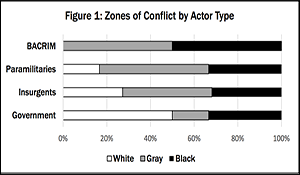
More specifically, extensive focus is directed to the role of the myriad, violent non‐state actors (VNSAs) present in each conflict. The case studies elucidate that given the confluence of a diverse array of actors and the seven distinct instruments of power (diplomatic, informational, military, economic, financial, intelligence and legal), which can be leveraged in prosecuting the conflict within White, Gray and/or Black domains, Gray Zone environments are particularly complex. Beyond merely illustrating this fact, the country reports are designed to help bound the scope for practitioners attempting to understand and possibly intervene in these dynamics. This is accomplished in two ways. First, we observed that actors of the same type largely behave comparably when facing the identical types of adversaries within the same conflict. Consequently, actors can be aggregated by types (e.g., treating various leftist insurgencies as a group or collapsing the myriad localized Islamist groups into a single category in Libya) without substantial loss of fidelity.
While the use of the aforementioned typology is helpful, the studies’ real innovation is that they focus on conflict dyads. Rather than consider the entire conflict – with its still numerous actor‐types – as a whole, these reports break down and analyze the conflict one dyadic configuration of belligerents at a time. We found that belligerents of the same type prioritize certain instruments and Zones when facing one type of actor and other instruments and Zones against other actor‐types. For example international legitimacy is very important for some types of VNSAs. Consequently, these groups may prioritize White and/or Gray diplomatic and informational instruments when confronting the government. However, Gray and/or Black Zone activities within the military instrument may predominate in their conflict with other VNSAs, since these dyads are less likely to affect international perceptions. The average Colombian conflict dyad involves just 2.5 of the seven instruments. In Libya, the average is a bit higher at 4.5 instruments. However, on average, just 2 are particularly salient. Ukraine similarly experiences an average of 4.5 relevant instruments of power across all dyads. Nevertheless, this average is inflated by the Ukrainian government versus Russian government dyad, which involves all seven instruments.
This report proceeds in four sections. The first section provides background on each case and the relevant actors therein. The subsequent section describes the data leveraged and the methodology employed by the studies. The penultimate section elaborates on the approach utilized and key findings. The final section concludes. In doing so it also offers advice for practitioners.
Author | Editor: Popp, G. (NSI, Inc).
This video is a brief overview of the Strategic Multi-Layer Assessment (SMA) team’s Project Noor effort in support of USCENTCOM. Over the past year, the SMA Reach Back Cell has produced a vast corpus of knowledge and insight in support of key USCENTCOM questions regarding Syria and Iraq. On its own, this 1000+ page (and 50+ report) collection of documents is a valuable resource, but due to its sheer size and density, it might prove difficult to fully consume and absorb. Therefore, Project Noor seeks to provide USCENTCOM with a quicker, easier, and more effective way to search through and make effective use of this vast treasure trove of information.